Friday, 2 May 2014

Retrospective Planning Roulette

This is a planning game to help organize team retrospectives with a difference. Its a great activity to run in a scrum master community of practice when discussing retrospectives.

Required:
Copy of "Agile Retrospectives: Making good teams great" by Ester Derby and Diana Larsen
Queue Cards
Colored Markers
Whiteboard
Magnets or bluetack
4 Scrum masters (I had enough Queue cards for 4, if you have more just write more cards)

You will plan a number of different 5-stage retrospectives for all your teams at the same time. The book is organised into activities that support each stage of the retrospective.

Instructions:
  • Write out the exercises from the chapters 4, 5, 6, 7 and 8. It helps if you use colors. These are exercises that support: Setting the scene, Gathering Data, Generating Insights, Deciding what to do and Closing the Retrospective.
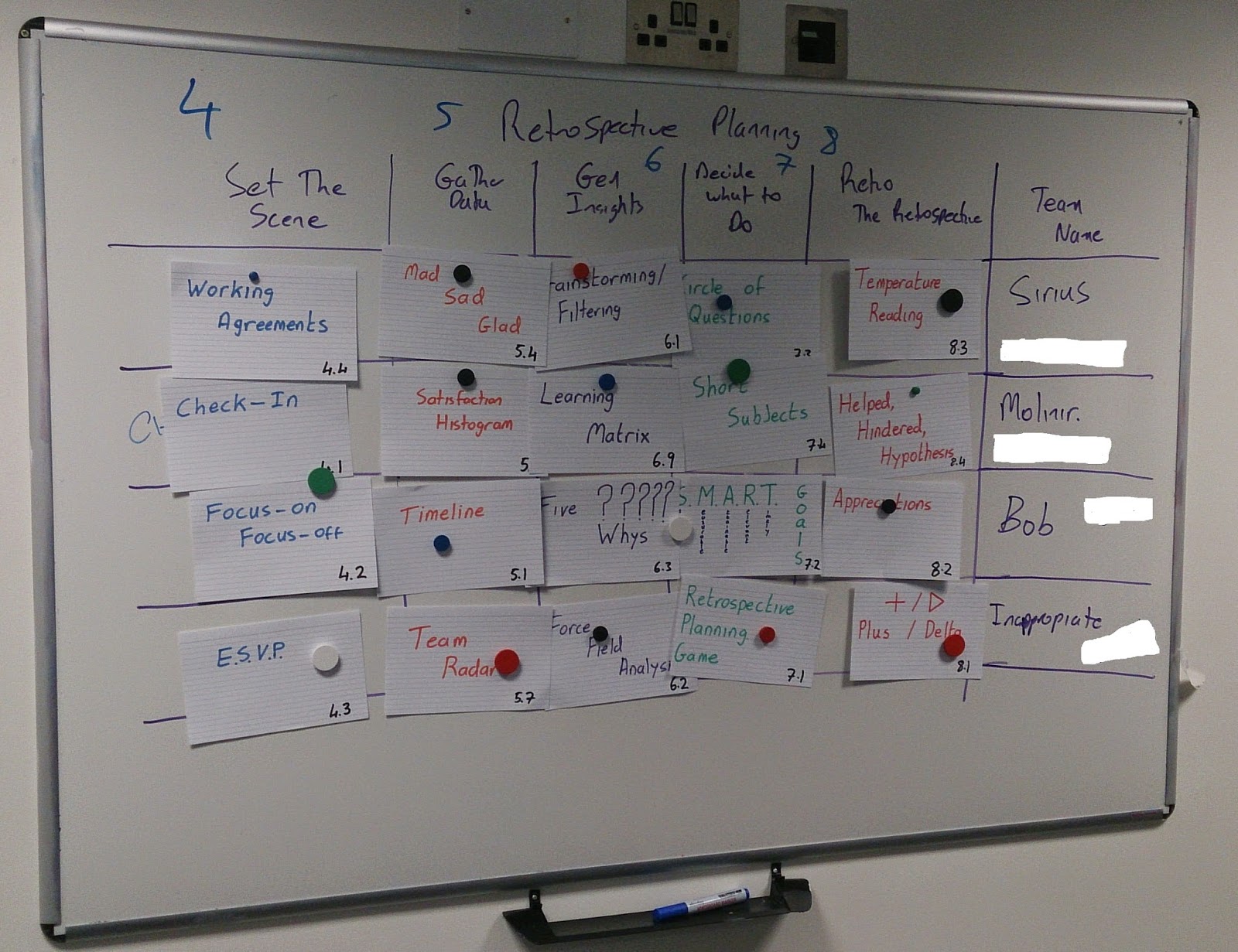
  • Now lay all the cards out on the table in columns according to chapter. See photo.
  • Next you lay out the whiteboard. So across the top put the 6 columns. One row per team. Now you are ready to play. Here we have 4 teams.
  • The next step is to get the scrum masters to choose from the laid out cards which activities they will use to run the retrospective. It doesn't matter if they don't know what that activity is as its described how to do it in the book. All they need is on the queue card.
  • You end up with something like this: Here you have 4 teams retrospectives planned out. For example 

  • Now each scrum master has an agenda put together. The instructions for each task are in the book quoted above. 
  • Its good to follow up this activity to see how did the scrum masters get on. And you can easily re-run it to get another retrospective agenda filled.
  • FYI after we had done this I found this website that does the same thing with an online version. http://www.plans-for-retrospectives.com

Thursday, 10 April 2014

Failure in scrum mastering and project management.

Project management typically tries to identify failures (risk) and takes actions to avoid those from happening.

In scrum mastering, we let the team fail and fail as fast as possible. We then help the team to learn from that failure.

Friday, 28 March 2014

What happens when you ignore scrum in an scrum based agile environment

Agile Chaos... Everyone tries to do everything and very little gets done and quality goes out the window. Worse is that developers will perceive scrum as a problem rather than a solution. As a scrum master and guardian of scrum, it's one of your biggest fears! Forget about the sprint failing, this is when agile fails.

Scrum
Scrum: a process where short, fixed scope iterative cycles are used to deliver software over a long period of time. Scrum promises the fixed space to developers to allow them to be creative, while offering the customer the flexibility to change the product. A win win.

So the team gets the X weeks space to work on something and during that X weeks the organization issues are supposed to go on the backlog and, if the PO agrees, be prioritised to the top to be tackled in the next sprint. So you could have a possible x weeks needed to turn around your issue. 

Reality
But how often do we see that managers or PO's just can't help themselves tinkering with the sprint backlog. As soon as the customer or stakeholder get off the phone with a question, suggestion or complaint, they have to have a developer that MUST look at this new revelation TODAY!

Well lets look at the effects this have on the developers in the team.

Context switching goes up. What the developer was working on yesterday, must be dropped to look at this new thing. Then when we have brought it to resolution, that developer switches back to what they were looking at. "Now where was I?"

Trust in the PO and Scrum master goes down. The team recognize they didn't get the space as promised by the PO and the scrum master couldn't prevent it. "I thought the scrum master had our backs"

Commitment excuse. We are now trying to fit more work into a short iteration. This means our original goal is probably unattainable unless overtime is called for. "Well we could have got that finished, but..."

Morale down. Trust is down, our goal looks out of reach. We have to work longer hours just to make up. "There goes my Saturday..."

Quality down. "If I have to work overtime, well dammit I'm gonna take a short cut. We can fix it up next sprint."

Amount of testing down. "We haven't got time to put in those negative scenarios. We'll pick a few to give us good coverage and leave it at that?"

What can a scrum master do prevent this from happening?
Scrum masters should have the power to stop a sprint and call a re plan. Also scrum masters have the power of informational at their hands. They can publicize the effects as observed so that Product owners realize the consequences of their decisions on the team and on the product. 

When reviewing the sprint, make sure you highlight what was added at an inappropriate times during the sprint. 

The advantage of using a tool like JIRA is that the story or task history gives you evidence of the amount of context switching in a team. It should be universally recognized that context switching is inefficient in the organization. So highlight the history of stories during a chaotic sprint as evidence.

Trust and Morale are much less tangible to highlight. But it also means you have to work harder to increase both when you recognize they are down.

Quality and testing are much more tangible to show. There are lots of statistics out there you can gather on your product. Be weary that teams will design towards quality metrics if the quality metrics are a stick to beat the team. Quality metrics are evidence for management to give the team room to take some action.

When was the last time you accepted work into the team during the sprint? When was the last time you stopped the sprint? A scrum master should have the power to do this. 

Scrum should be about sustainable pace. When you are in chaos due to too much flux, make sure you call it what it is: Chaos. If scrum is confused for chaos, people will not see scrum as a solution, but as a problem. 

Lesson
The ultimate realization here is that there is more than the Scrum master protecting the team. The product owner needs to realize how they fit into the picture of the team. This is easier to do if you consider the product owner as part of the team. However if your organisation doesn't consider the PO part of the team, it's a bit harder. The scrum master has to go to more effort to make them realize the consequence of the product owner not absorbing the majority of that flux driven by the stakeholders. 

Tuesday, 18 February 2014

Winston Wolf... A scrum master from the movies!

"I'm Winston Wolf, I solve problems..."

This is the introduction from Harvey Kietel's character in the movie Pulp Fiction.

Better quality version
Low quality, but longer clip

Here are some of the excellent Scrum master qualities Winston demonstrates in this clip.

  1. Skin in the game. He puts "skin in the game" by showing up to the crime scene. He's now as guilty as the rest of them. 
  2. Team. He forms the team. The four guys in the house are the team. They are all in together in the one situation. The husband is part of another team (husband and wife), but the Wolfman takes subtle control of him and takes him into this team using a clear vision, providing a service and providing compliments. 
  3. Trust. He immediately builds the relationship and trust. 
    1. Reputation. He comes with a reputation and he makes sure they know it. Sets a seemingly impossible task to start with. Surpasses expectations. (He shows up at an impossible 20 minutes early.) 
    2. Commitment language. He states "He will solve the problems."
    3. Respect. He knows names. Respects his fellow team mates. Commands Respect from the guys.
    4. Forms a bond, establish a relationship immediately.
  4. Belief. They believe he can solve their problem. He uses positively and commitment language to instill this belief.
  5. Time lines. He understands the deadlines. He ensures everyone else knows the deadlines too by repeating them. 
  6. Calmness. Cool head under tight deadlines. Understands the situation. Knows the facts of the case, but is never flustered or excited. Looking at the ugly crime scene, he looks for coffee... I'm so cool under this pressure, I want coffee. 
  7. Complements & treats. Small things really help the situation given the pressure. When he gets the coffee he's thanks and compliments the guy who makes it. He makes some jokes at various times.
  8. Disciplined. Enforces discipline. Comes across as curt, but then explains himself as he has no positional power.
  9. Urgency. He "thinks fast", he "acts fast". All times he conveys the sense of urgency, while not being hasty or flustered. He is calculating and organised. He arrived 20 minutes early!
  10. Everything is delegated. Notice that he actually does none of the "Hard Labour"... But note that he asserts that he has expertise in the area. Even though he never lays a hand on anything other than the coffee cup, the team believe he can help them.


Updated 22/11/2017

Wednesday, 22 January 2014

A short discussion on code coverage

What is code coverage? 
Code coverage is a measurement of the lines of code executed during a test. Usually this is aggregated together over a number of tests, to give a suite code coverage metric. It is a measurement that is easy to obtain automatically as there are lots of tools out there to measure it for you. It is usually expressed as a percentage of the lines of source code executed. It is can be used as an indication of quality of the test suite, however like all statistics it needs to be used in the correct context.

What does it indicate? 
Low levels of code coverage indicates that our automated test harness does not do a very good job verifying the entire components' source code. We cannot be confident that the changes we made in this release will not effect some of our users out there in the world.

Hmmm so a higher number is better? 
Yes. Higher numbers can mean we have a very good test suite, but does not guarantee it. When developers use code coverage as a targeted Key Performance Indicator (KPI) when writing tests, a small subset of the required tests would give an artifically high code coverage metric, while leaving little or no confidence in our test framework. It is amazing how many times managers put a coverage KPI on developers. This usually results in an artificially high coverage metric, typically 95+%

So we should have 100% then?
Absolutely. Why not? If the code is well structured AND you thought of all the tests required, it should be pretty near it. You will always have code, like logging, tracing and certain "aspect" type or cross cutting work that you may not test because its not actually business logic or effects business logic. If the code is legacy code the cost of introducing a test framework to reach high levels of code coverage may not be worth the effort. You should instead aim to write the most popular/common test cases and just use code coverage to see help indicate future refactorings/removal of code. 

100% code coverage means 100% confidence? 
Absolutely not. Not even close to 100% confidence. 100% code coverage does not mean we have written 100% of the tests that ensure our code is working. Only 100% of the tests required to test a component ensures confidence when future changes are made.

So I need 100% of tests? 
Exactly. Thats all that matters. Thats what we really should be striving to write, not to hit a coverage limit of 80%, 90% etc.

Can I automatically measure % tests I have written? 
No... not without a clever human involved. This is where a good automated tester earns their bread and they are worth their weight in Gold. Literally.

Tuesday, 26 November 2013

Some Jack Donnaghy leadership advice thats best avoided

Some stuff a scrum master should probably refrain from doing, no matter how bad your day or week goes...

"Use fear when reason fails"

"Maintain upper hand by delivering backhanded compliments"

"Follow a proven strategy"

"Quote random statistics to prove your point"

While they are hilariously effective, the side effect is to wreck your team.

Thursday, 14 November 2013

Thoughts, trials and tribulations...

Well it had to begin somewhere...

I'm a scrum master, working in a development team in Ireland. I wanted to start a blog to re-enforce my learnings as I go about gaining more experience as a scrum master.

I enjoy scrum mastering... High performing teams producing quality software interests me. I am also a geek at heart. I enjoy technology. I enjoy coding, "wiring" software components together to produce something useful, that makes our lives better. I relish doing a good job and take pride in a great product. I think software creation is more craftsman ship than engineering, but engineering principles are very useful to produce it. I am firmly in the camp that the scrum master must be technically very strong and they must keep their programming and engineering skills current. I subscribe to the Agile manifesto.

I think I am a rare, if not unique, type of scrum master.

Anyway I hope to write about a few of my positive and negative experiences here. Sharing is caring. A problem shared is a problem solved.

Cheerio...